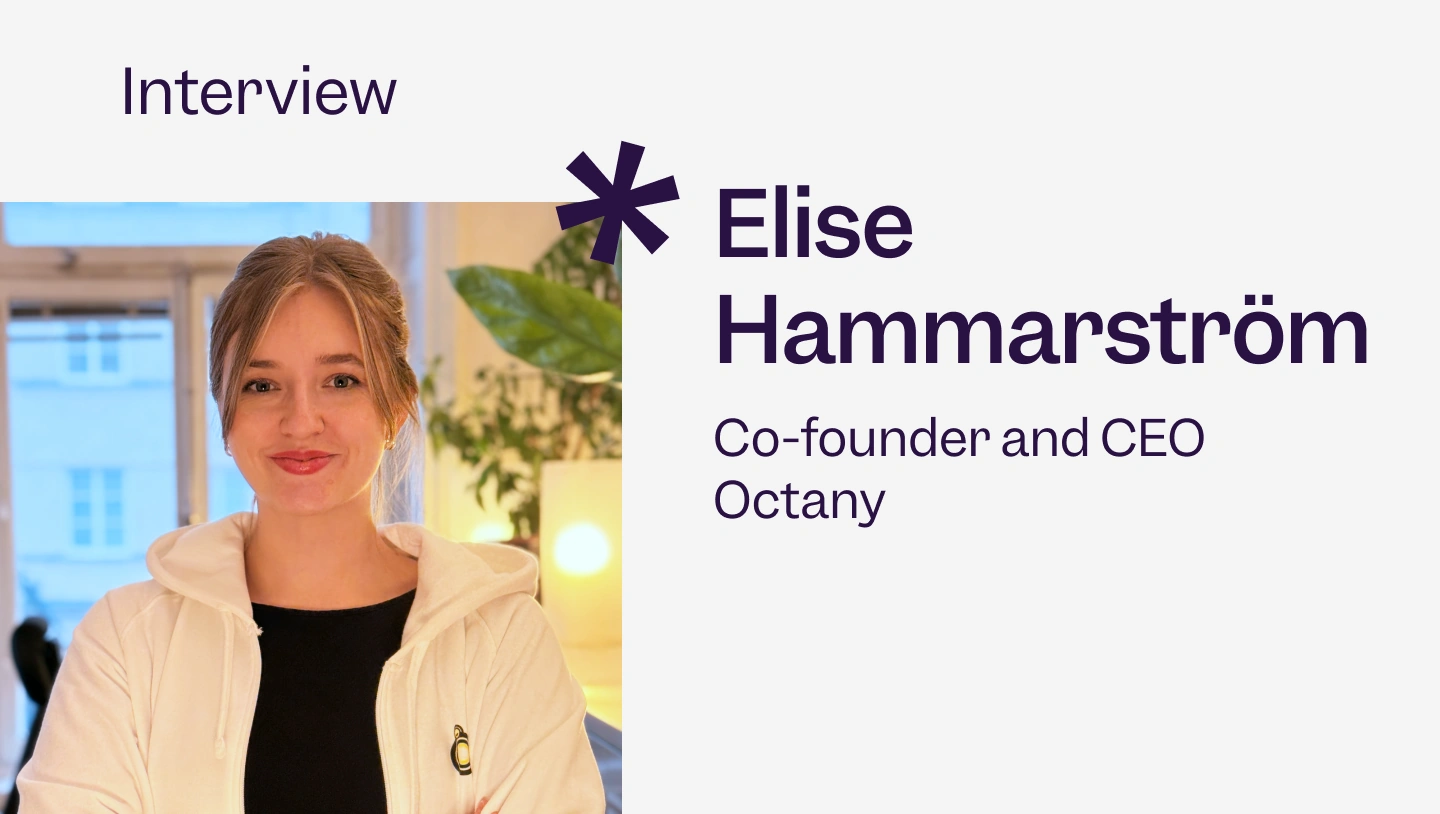
In charitable giving, donors often face frustrating paperwork that separates their intentions from their actions. Despite being 2026 and the world very much online, many nonprofits still use manual forms, leading to what Elise Hammarström, CEO of Octany, calls “donation anxiety.”
Octany was built to bridge this gap. Their seamless, “all-in-one” platform makes supporting a cause as easy as an e-commerce checkout. By automating donations and simplifying setups, Octany saves donors time, reduces abandonment, and enables nonprofits to receive ongoing support efficiently. Central to this mission is their partnership with Brite and its Data Solutions offering, whose Open Banking technology is helping enable donors to set up recurring payments.
Brite sat down with Elise to learn how Octany’s transparent approach removed friction from the donor journey – and helped one client increase Autogiro (direct debit) signups by 24% in a month.
Can you describe what Octany does?
Elise Hammarström, Co-founder and CEO of Octany: Octany is a fundraising platform with all-in-one donor management. Its core purpose is to grow one-time and recurring giving through a charity’s website and communications. We offer a unified flow for monthly donors, memberships, one-time gifts, donation campaigns, corporate gifts and a donation shop.
Working with nonprofits, our purpose is to develop intuitive tech solutions that streamline their donor acquisition. Octany offers a fast checkout that supports recurring payments with Swish, card, Autogiro (Direct Debit), Google Pay, Apple Pay and provides invoice payments for individuals involved in company collaborations who make corporate donations.
Our platform provides seamless control over donors and revenue, handling both collection and donor management aspects. Essentially, we aim to provide the best fundraising platform available.
What inspired the founding of Octany, and how has your mission evolved?
Elise Hammarström: In 2017, two of Octany’s founders, who had worked in web development and digital payments since the early days, received a request to build a solution that unified all donation flows and payment methods for a large Swedish nonprofit.
Back in 2017, direct bank transactions weren’t even a thing. The client experienced complicated and fragmented donation journeys and lacked a solution to unify all payment methods into a single system. This meant their fundraising team lacked a unified view of the donor, as data for one donor could be spread across multiple systems depending on what and when they had given.
Additionally, their accounting team had a challenging time gathering all the necessary data for accurate accounting of all transactions. A solution was therefore built for this client. Not long after, more organisations reached out, saying they had seen what we had built for that particular client and wanted a similar solution. Thus, Octany was born as a standalone and fully self-serve fundraising platform in 2017 and scaling rapidly since 2019.
Our mission has evolved from solving a core payment problem in the early days to building a fully-fledged fundraising platform. Today, in addition to payments, we also focus on communication and analysis, and have developed our platform in all three of these areas. Our mission from day one has been to build a great fundraising platform, in all that it entails.
What are the challenges nonprofits face when setting up and managing recurring donations?
Elise Hammarström: Many nonprofits lack the resources or budget to develop an in-house solution for setting up and handling recurring donations in a digital and frictionless manner. As I’ve met many clients, my experience is that only the very big organisations might have a seamless donation flow, but that also comes with a recurrent cost of maintenance. However, midsize and smaller companies often lack a solution and struggle to allocate the resources, time, or budget necessary to implement something intuitive, smooth, and easy to use.
As such, many clients have donation flows where the donor manually enters their bank account details in a way that is often non-intuitive and is frankly a really long form. Now I use this word in terms of product, but it gives the donor “anxiety” to see that very long form with a lot of manual entries. The intention to give easily diminishes – especially if you see that some fields require information that you don’t know by heart, such as bank account details. Many donors – myself included – don’t know their clearing and bank account numbers by heart. Long manual forms are an unnecessary step when more intuitive and frictionless solutions exist, such as signing with Mobile BankID, which is secure, accurate, and quick.
The other part of that question is data integrity. From my experience, many nonprofits today handle a large number of manual file uploads into, let’s say, a central system, and they upload them manually on a daily basis. They also have a lot of donor information scattered across multiple systems. We consolidate everything in one system, and we automatically send files daily to Bankgirot for those Autogiro transactions.
Essentially, we limit manual work and ensure that debit and credit integrity is consolidated and secure, and of high integrity. Instead of having scattered information everywhere and relying on manual uploads, we unify everything in one platform and use automatic uploads.
How does your experience help organisations address these specific challenges?
Elise Hammarström: In Octany, everything is unified: you have all your fundraising streams, regardless of whether it’s a monthly donation, a one-time donation, a membership, a donation campaign, a gift shop, donation letters or your company partnerships. You have access to all your payment methods and all your donor data. Additionally, we also automatically handle the nonprofit’s bookkeeping needs for all transactions. This allows fundraising teams to save time, streamline processes, and focus on what matters most: deepening donor relations and delivering value to society in line with their purpose.
All of our solutions are carefully designed and developed, ensuring that every charity offers a donation experience that is both enjoyable and strengthens the relationship with the donor. During 2026, we’ll take the next step in helping our organisations engage with their donors by sending campaigns with email & text messages – and we have more features planned in our roadmap for the year.
Has personal experience working with nonprofits influenced the design features of the Octany platform?
Elise Hammarström: Everything has been influenced by that. Octany was born and raised to solve a specific fundraising problem. We haven’t tried to morph from one domain into this. Octany solves the specific problems of fundraising teams, designing the user experience with their needs in mind.
To build a great product, you need to have exceptionally deep knowledge and understanding of your audience. You have to understand what problems they have today and find possible solutions, along with projecting the needs of tomorrow and trying to predict what might be desirable in the future. This encompasses both donor acquisition and care, but also in building experiences that enables fundraising teams to do their best work yet.
The most critical aspect of building any business, and what we also do at Octany, is to consistently maintain that connection with non-profit organisations, foster trust, and keep communication open with our clients. It is the core of our product strategy and our operations.
What are the long-term goals for Octany?
Elise Hammarström: As you know, our solution is highly flexible, addressing recurring and one-time transactions, as well as the administrative challenges that arise with growing a recurring business. That said, we will continue to be focused on solving the unique challenges of nonprofit organisations. They have real, unique challenges that are not met by other technical solutions, and they have their own specific needs.
However, as you may have guessed, we plan to expand in the Nordics, not only serving Sweden as a market, but also all Nordic countries. That’s the next logical step.
Why did you choose Brite as a technology partner?
Elise Hammarström: We had another solution before, and their account-fetching solution was basically a black box for our tech team. We saw that donors entered the process; they attempted to provide their account details, but we couldn’t determine how far they’d progressed through the flow or if they encountered any issues along the way. We wanted to have better transparency of the donor journey through these critical steps in acquiring bank account details.
That’s why we chose to look for another solution, and with Brite, our technical requirements were met. On a deeper level, we also “clicked” in terms of how both of our companies approach building a business. It was clear that Brite actively works with continuous improvement and feedback, and that was also important for us, so we can both grow in parallel together, as new needs arise over time. We continue to strengthen our partnership and find technical solutions as new needs arise.
What were the core problems that Brite helped solve, in relation to the friction and failure rate of setting up new recurring donations?
Elise Hammarström: The black box explanation is still applicable here as well, in that we wanted to see the donors going through all the steps. We wanted to have more information about the bank account fetching. However, in terms of friction and failure rate, our previous solutions revealed that some banks had a higher likelihood of errors than others.
With a previous partner, some banks often didn’t provide a success status. Yet with Brite, we not only solved that problem by providing a more stable solution for fetching all bank account details, but we also gave our donors more options in terms of banks. Our previous partner had many banks to choose from, but with Brite, we had even more banks to offer the donor. Therefore, regardless of which bank a donor uses, it will most likely be available to choose from.
You mentioned seeing your success rate for Autogiro signups improve by 24% in the first month. What contributed to this lift?
Elise Hammarström: The solution we had previously wasn’t very stable, especially for one or two banks, which continuously raised customer support questions about why a particular donor didn’t go through. Brite is simply more stable, and we saw an increase in conversion in the first month. By essentially making the change. A more stable bank account fetching solution.
How does Brite help your clients reduce their administrative burden?
Elise Hammarström: Instead of clients’ donors entering their bank account details manually, which often yields errors, we offer automation. With no manual entries, account details are less likely to be faulty, which is a great benefit for both our customers and their donors.
We also have a fallback option, in case a donor has a less well-known bank; they can still enter it manually if they wish to do so.
Want to know more?
If you would like to know more about how Octany works with Brite, then check out our full case study below.
Alternatively, if you would like to discuss your donation payments directly with Brite, please get in touch and speak with one of our payment experts today.